
Most AC repairs in Tampa Bay come down to a short list: a failed capacitor, a clogged condensate drain, a dirty coil, a refrigerant leak, a contactor, or a blower motor. In August, the capacitor usually waits for the hottest hour of the hottest day, because it has a sense of drama. Knowing which one you're looking at changes what you should expect from whoever comes out — and keeps a $200 problem from being sold to you as a $9,000 one. This page is the plain-English version of that list.
Opening soon. Sunny City Cooling isn't booking jobs yet — this page is here to help you understand the work first. Join the launch list and we'll email you the day we open.

Sunny City Cooling technician — every AC repair starts with measurements, not a verdict
Sunny City Cooling · Wesley Chapel, FL · more than 60 years of combined field experience on the team.
How do you know it's time for AC Repair?
Check what you're seeing at home:
What these repairs usually run here
Ranges for Tampa Bay homes, not a quote. A real number needs eyes on your system.
$150–$350
- Part is cheap; the visit is most of it
- Dual-run vs single
- Whether the contactor went with it
$150–$400
- Often replaced together with the capacitor
- Burnt wiring adds labour
- Surge damage upstream
$120–$300
- How far the clog sits
- Whether the pan overflowed into drywall
- Adding a safety float switch
$400–$1100
- ECM vs older PSC motor
- Part availability for the brand
- Whether the wheel is also shot
$900–$2500
- Cased vs uncased
- Refrigerant type — R-22 systems change the maths
- Age of the outdoor unit
$350–$1600
- Where the leak is
- How much refrigerant the system holds
- R-410A vs R-22 pricing
The short list — what actually fails on Florida systems
| Symptom | Most likely cause | What it means |
|---|---|---|
| Outdoor unit hums but the fan won't spin | Failed run capacitor | Small part, common failure, quick fix |
| Nothing runs outside, blower runs inside | Contactor, capacitor, breaker or safety switch | Electrical, usually same-visit |
| Water on the floor by the air handler | Clogged condensate drain line | See our leaking-water guide — often DIY |
| Ice on the coil or copper lines | Low airflow or low refrigerant | Filter first; if it re-freezes, it's a leak |
| Cool but never cold, bill has jumped | Low refrigerant, dirty condenser coil | A leak is not a top-up |
| Loud grinding or screeching | Blower or condenser fan motor bearings | Shut it off before it seizes |
| Runs constantly, never satisfies | Undersized, leaking ducts, or low charge | Diagnosis before parts |
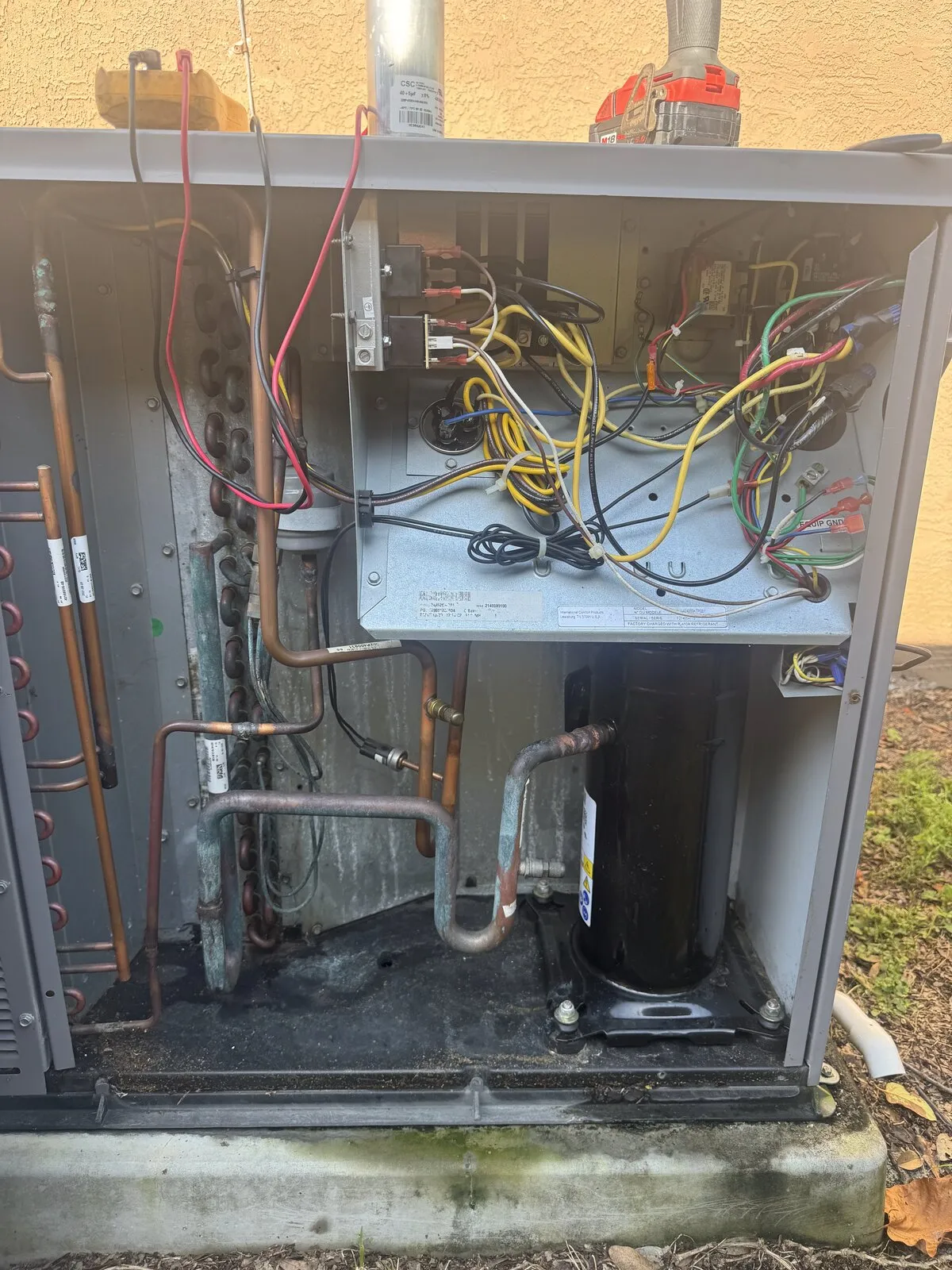
Why the same leaks keep showing up here
Our owner, Anatoli, on the pattern behind a lot of Tampa Bay repair calls:
Manufacturers compete on price through material — the thickness of the copper, or using aluminium instead of copper. In the cheap units the condenser and evaporator are basically all aluminium. Aluminium takes thermal load badly and develops microcracks, especially when it's badly insulated and sitting in the sun. The refrigerant leaks out of those microcracks and the leak is hard to find. Those systems live around seven years in normal conditions.
Two practical consequences for anyone getting a repair quote:
- A refrigerant "top-up" is a diagnosis, not a repair. Ask where the leak is. If the answer is vague, ask what was used to find it.
- Age plus aluminium changes the maths. A weeping evaporator coil on a seven-year-old budget system is where repair stops being the obviously better choice.
Who you're actually hiring
Air conditioning repair in Tampa, FL is sold by three quite different kinds of business, and knowing which one is in your driveway explains a lot about the quote.
The large HVAC companies run big fleets and heavy advertising. Response is fast, the technician is often on commission, and replacement is proposed early and often.
The small independent air conditioning company — usually the owner plus one or two technicians. Slower to answer in August, generally cheaper, and the person diagnosing your AC system is the person whose name is on the truck.
The one-truck operator. Excellent or alarming, with little in between. Check the license number against the state database before anyone touches the equipment.
None of those is automatically right. What matters is whether the technician measures before concluding, and whether the HVAC service you're quoted matches what the air conditioning system actually needs.
Three quotes for the same dead capacitor: how to read them
A failed run capacitor is the most common AC repair in Florida, which makes it the best example of how the same fault produces very different quotes. Here's what tends to sit behind each number.
| What the quote says | What's usually inside it | What to ask |
|---|---|---|
| A small number, capacitor only | The part, a few minutes' labor; sometimes a "while I'm here" list follows | "Did you measure the old one, and what did it read?" |
| A mid number, "capacitor and service" | The part, plus a coil rinse, a drain flush, a contactor check — often genuinely worth it | "Which of those did the system actually need?" |
| A large number, "capacitor, hard-start kit, surge protector, and…" | Add-ons that may or may not fit your system; a hard-start kit on a healthy compressor is unnecessary | "What did you measure that says the compressor needs help?" |
None of the three is dishonest by definition. The difference is whether the add-ons follow from measurements. A technician who shows you 31 µF on a 45 µF capacitor and a compressor pulling normal amps has earned the first quote; the third one needs a reason.
What you can safely do yourself, and where the line is
| Safe for a homeowner | Leave to a technician | Why the line is there |
|---|---|---|
| Thermostat, batteries, breakers, filter, clearing the outdoor unit | Anything inside the electrical compartment | A run capacitor holds a charge after power is off; it will remind you |
| Vacuuming the condensate drain line from outside | Refrigerant of any kind | Licensed work, weighed charges, and the wrong gas damages the compressor |
| Rinsing the condenser coil, power off, from inside out | Coil cleaning with chemicals | Wrong cleaner, wrong dilution, and the fins go soft |
| Reading the data plate for model and age | Replacing motors, boards, contactors | Wiring mistakes take out the board you were trying to save |
The Sunny City Cooling team has more than 60 years of combined experience, and the one thing that experience buys is a very accurate sense of where that line is. Everything in the left column is yours. Everything in the right column has a story behind it.
What a proper diagnostic visit includes
If someone tells you what's wrong without doing most of this, they're guessing:
- Thermostat and control check
- Filter and airflow check, including static pressure
- Evaporator and condenser coil condition
- Refrigerant pressures and superheat/subcool, compared against the equipment's own spec
- Electrical: capacitor microfarads measured, contactor inspected, amp draw on the compressor and both motors
- Condensate drain and float switch
- Findings written down, with the measurements, before any part is proposed
You're entitled to the numbers. A capacitor rated at 45 µF measuring 31 µF is a fact you can see. "It's just old" is not.
What you can check before anyone comes out
- Thermostat on COOL, fan on AUTO, batteries fresh.
- Breakers, including the outdoor disconnect box by the condenser.
- Filter — if light won't pass, replace it.
- Outdoor unit — clear two feet around it, remove anything leaning against it.
- Drain pan — if it's full, the float switch may have shut the system off on purpose.
That list resolves a genuine share of "my AC is broken" calls, and nobody is embarrassed by checking it.
Getting a second opinion
Second opinions are normal and good. If a repair over a couple of thousand dollars or a full replacement is being recommended, ask for:
- what failed, and the measurement that proves it
- whether the part is still under manufacturer parts warranty (10 years is common, to the original owner)
- the repair option alongside the replacement option, both in writing
Any contractor who reacts badly to those three requests has told you something useful.
On pricing, and on seasons
We don't publish firm repair prices, because an honest number depends on what's actually wrong, and we won't quote work we're not yet booking. What we will commit to now:
Our prices won't move with the season. In this market they often do — the same repair costs more in July than in January. Ours won't. There will be a published price list and options, and you'll choose by what you need rather than by how hot it was the day your system quit.
Repair, maintenance, installation — which one is this?
Homeowners often call for air conditioning repair when what they need is an AC maintenance visit, or the other way round. The distinction:
| It's a repair when | It's maintenance when | It's installation or replacement when |
|---|---|---|
| Something has failed and the AC system won't do its job | Nothing has failed and you'd like to keep it that way | The repair cost is a large share of a new system, or the equipment is at the end of its life here |
| Diagnosis first, part second | A fixed checklist on the whole HVAC system | A load calculation first, equipment second |
Getting this right saves money in both directions. The same logic applies in January: heating repair on a heat pump is this page with the seasons swapped. A capacitor found during an annual visit costs less than the same capacitor found at 9 p.m. in August — and indoor air quality problems, which frequently masquerade as cooling complaints, are almost always found on a maintenance visit rather than a repair call.
Where we'll be working
Wesley Chapel, Lutz, Land O' Lakes, Zephyrhills, Dade City, New Tampa, South Tampa and the surrounding Pasco and Hillsborough communities. Those places aren't interchangeable — water-related code zones, flood elevation requirements and the age of the housing stock differ enough to change the job.
AC Repair: your questions, answered
How much does AC repair cost in Tampa?
It depends on the failure. A capacitor and a compressor are different orders of magnitude. We publish ranges in our cost guides rather than a single number, and we aren't quoting repair work until booking opens.
What is the most common AC repair?
A failed run capacitor, followed closely by a clogged condensate drain line. Both are inexpensive and both are frequently over-sold.
What's the average lifespan of an AC unit in Florida?
Shorter than the national figure. In our owner's experience, budget all-aluminium systems run about seven years here; well-installed copper-coil systems reach 12–15.
Is it worth repairing a 10-year-old AC?
Depends on the part. A motor or capacitor, yes. A compressor or evaporator coil on a ten-year-old system usually argues for replacement — run the four questions on our replacement page.
How often should AC maintenance be scheduled in Tampa?
Once a year at minimum; twice suits a system that runs nine months a year. Most of the repairs on this page are preventable by the drain, coil and electrical checks in a tune-up.
Do I need to be home for a repair?
For the diagnostic, yes — you're the one who can describe what it was doing at 3 p.m. on Tuesday, and that's often the most useful data anyone has.
Be first in line when we open in Tampa Bay!
Texts and messages get the fastest replies — leave your contact and you'll hear from us the day booking opens.
(813) 393-7911