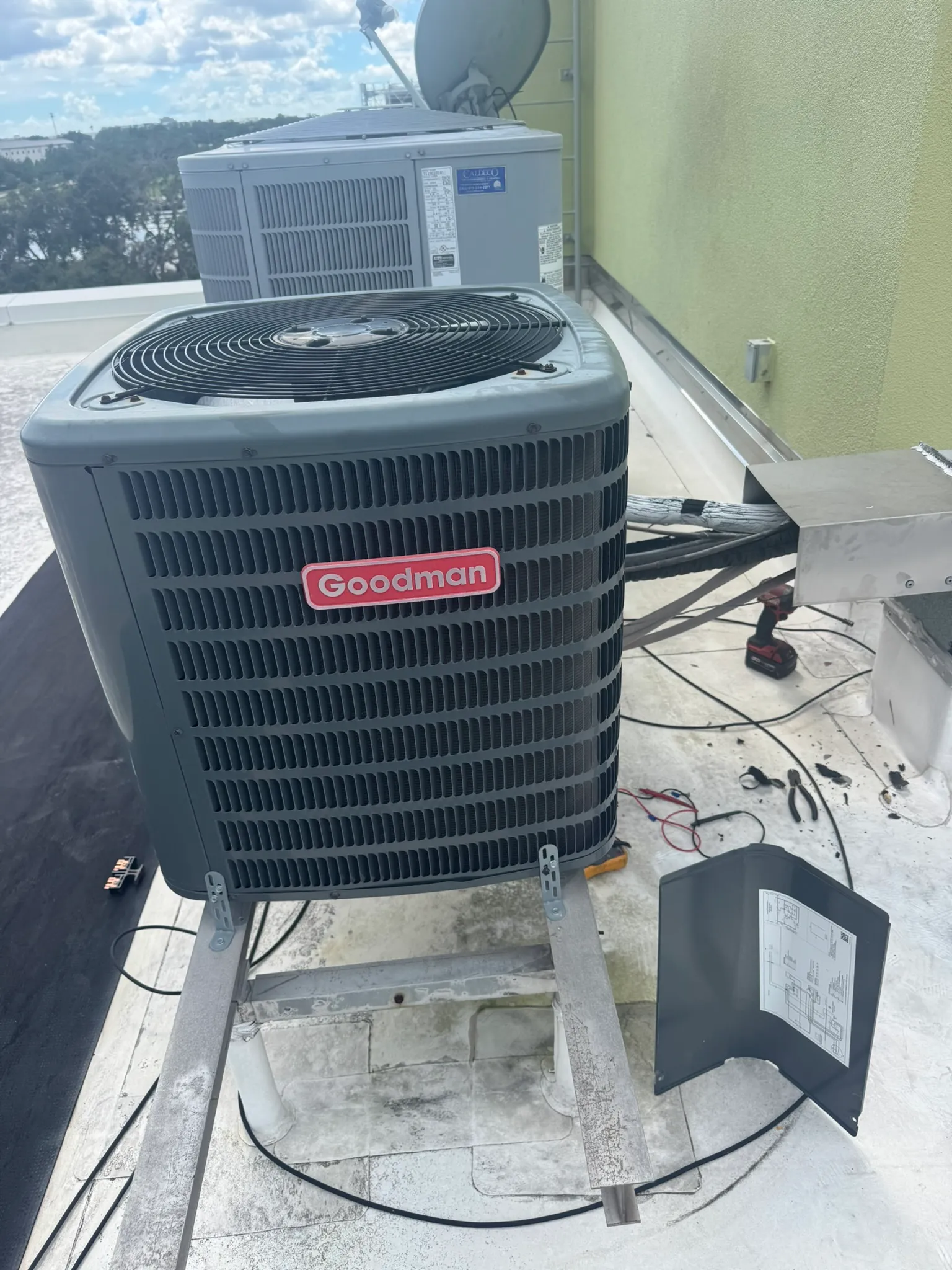
We're independent: we service every major brand's equipment and recommend what fits your home — not what hits a dealer quota. Every brand below gets an honest owner profile; when you're shopping, the buying guide further down compares the tiers without a sales pitch.
All of the majors — Trane, Carrier, Rheem, Mitsubishi Electric, Goodman and Lennox — and the sibling nameplates built in the same factories: American Standard, Bryant, Payne, Ruud, Amana, Daikin and more. Compressors, coils, capacitors and control boards are the same trade on every unit; what differs by brand is the fine print — parts channels, warranty terms, and the specific ways Florida heat, salt air and lightning get to each one. That's exactly what each profile below covers.
The badge on the door — the model number on the data plate tells the real story.
The brands, one honest profile at a time
Each profile is written for the person who owns the equipment, not the person selling it: market tier, what the brand does best, and the thing worth watching before it costs money.
Trane
Premium
A premium line known for durable compressors and the proprietary Spine Fin outdoor coil.
Trane systems are common in higher-end Tampa Bay construction. Their all-aluminum Spine Fin coils resist Florida corrosion well, but are serviced differently from standard copper-and-fin coils. Typical service items we see on aging Trane units are capacitors, contactors and condenser fan motors — the compressors themselves tend to outlast the parts around them.
Strongest at: Heavy-duty build; corrosion-resistant Spine Fin coils
Worth watching: Priciest repairs when something does fail
Carrier
Premium
The company that invented modern air conditioning — a full range from budget to variable-speed flagship systems.
Carrier (with sister brands Bryant and Payne) spans every price tier, so 'a Carrier system' can mean very different equipment. Their Infinity variable-speed line needs technicians comfortable with communicating controls; the standard Comfort series shares parts widely with the rest of the industry.
Strongest at: The original AC engineering pedigree; broad lineup
Worth watching: Surge-sensitive boards — surge protection earns its keep
Carrier is our flagship brand — the full owner's guide to the 2025–2026 Carrier lineup, the R-454B refrigerant change and what actually fails on each model tier is live on the blog:Carrier AC in Tampa Bay — the owner's guide.
Rheem
Mid-range
Solid mid-market systems, widely installed across Tampa Bay — straightforward to service and well-supported on parts.
Rheem (and sister brand Ruud) is everywhere in Florida's mid-market housing. Parts availability is excellent, which keeps repairs fast. On older Rheem condensers we most often see contactor and capacitor wear, and drain pan issues on certain air handler generations.
Strongest at: Dependable workhorse; parts available everywhere
Worth watching: Capacitors are its usual summer casualty
Mitsubishi Electric
Ductless specialist
The reference brand for ductless mini-splits — garages, lanais, additions and homes without ductwork.
Mitsubishi mini-splits solve the rooms central AC can't reach: garages, converted lanais, additions, and older homes with no duct path. They're efficient and quiet, but they are not 'install and forget' — the washable filters need actual washing, and blower wheels in Florida humidity need periodic deep cleaning to prevent the classic musty-smell complaint.
Worth watching: Owner homework: washable filters need monthly attention
Goodman
Value
The value workhorse of Florida construction — inexpensive, everywhere, and easy to keep running when installed well.
Goodman is the most common builder-grade brand in new Tampa Bay communities, which means thousands of local homes have the same models aging on the same schedule. The equipment is simple and parts are cheap and universal — the brand's reputation problems usually trace to rushed builder installations, not the hardware itself.
Strongest at: Lowest cost of entry; strong published parts warranty
Worth watching: The warranty leans on registration and maintenance records
Lennox
Premium
High-efficiency specialist — top-tier SEER2 ratings, with proprietary parts worth understanding before you buy.
Lennox pushes efficiency hardest of the major brands, and their flagship systems post some of the best SEER2 numbers on the market. The trade-off Florida owners should know: more proprietary parts than average, so out-of-warranty repairs can cost more and take longer to source than with commodity brands.
Strongest at: Top published efficiency ratings; very quiet variable-speed
Worth watching: Tighter flagship parts channel can slow a repair
Don't see your nameplate? Most other brands are siblings of these six — and we service what's on your slab either way. The table below shows who actually builds what.
Who actually makes your brand?
Fewer companies than the logos suggest. Sibling brands share engineering and most parts — good news when a "premium" repair part turns out to have a twin under a cheaper label.
Sold as
Made by
What it means for you
Trane · American Standard
Trane Technologies
Same engineering and mostly shared parts; American Standard often prices a step friendlier.
Carrier · Bryant · Payne
Carrier Global
One platform, three price tags — Bryant and Payne are the value doors into Carrier engineering.
Goodman · Amana · Daikin
Daikin
The world's largest AC maker owns the value brand, the premium-warranty brand, and its own nameplate.
Rheem · Ruud
Rheem Manufacturing
Twins with different labels; whichever your installer stocks is the same machine.
Lennox · Armstrong Air · Ducane
Lennox International
Lennox keeps its flagship parts channel tighter than most — factor parts access into repairs.
Mitsubishi Electric
Mitsubishi Electric (US HVAC JV)
The ductless benchmark; in the US its heat-pump business runs through a joint venture.
Buying a new system? How to choose a brand honestly
Brand is the third most important choice you'll make. Right size for your actual house comes first, quality of installation second — refrigerant charge, airflow and duct sealing decide how any air conditioner performs, whatever the logo says. Brand still matters, third place is a real place: salt air eats coils, lightning kills boards, and 90% humidity runs compressors double shifts, and some brands handle that better than others. Reliability surveys of the Consumer Reports kind put the majors within a few points of each other — which is exactly why the installer gap matters more than the brand gap. We sell none of these brands and earn nothing from the rankings.
Nobody needs "a brand" — people need quiet, or low bills, or a number that fits the budget. Pick the priority; the guide names the brands that earn it.
Scope, so nobody wastes a scroll: this guide covers central air conditioning systems, heat pumps and ductless mini-splits — the equipment that cools whole Florida homes. Window air conditioners and portable units are a different purchase with different rules. And whatever the brand, an energy-efficient central air conditioner only delivers its ENERGY STAR sticker when it's sized and installed correctly — the rating assumes a perfect install that the market doesn't always supply.
Tightest budget, still reliable
The honest value play: equipment a tier down, installed carefully, beats premium equipment installed in a hurry. In this corner the warranty paperwork matters as much as the box.
Premium two-stage and variable models pair low noise with heavy-duty build.
Lowest electric bills
Efficiency is where the sticker ratings actually mean something — but only if the install matches the rating. A high-SEER2 system with leaky ducts bills like a cheap one.
Inverter-driven ductless sips power in the rooms you actually use.
Longest warranty coverage
Every major brand runs about 10 years on parts if you register within the window — the differences hide in compressor terms and fine print. Keep every maintenance record.
Also fields a credible ductless line if you want one installer brand across the house.
What about the other names on the truck?
Most of the "other" brands you'll be quoted are siblings of the six above: American Standard is Trane, Bryant and Payne are Carrier, Ruud is Rheem, Amana and Daikin share a factory with Goodman. Two genuinely separate names worth knowing: York, a century-old value line now under Johnson Controls, and Bosch, the inverter-technology newcomer that keeps showing up in quiet-home conversations. And on price: published national installed corridors run Goodman $3,200–$6,500, Rheem $3,000–$8,500, Lennox $3,500–$10,000 and Carrier $3,000–$15,000+ depending on line (HomeGuide, September 2026) — Tampa Bay quotes land 20–40% higher once county permits, hurricane straps and Florida labor are in the number.
The six majors, side by side
Three market tiers, one specialist. "Worth watching" isn't a defect list — it's the thing an owner should know before the salesman doesn't mention it.
Owner homework: washable filters need monthly attention
What owners actually pay for brand repairs
Brand loyalty is decided at repair time, not at the showroom — so here is the repair market itself. Three cost classes cover almost every air conditioner and heat pump failure, whatever the nameplate (published Tampa Bay repair pricing, September 2026):
Repair class
Typical parts
Tampa Bay corridor
The brand angle
Small electrical
Run capacitor, contactor, hard-start kit
$150–$450
The classic Florida summer failures on every brand. Universal parts are fine here — same-day fixes across all six majors.
Motors, boards & valves
Condenser fan motor, ECM blower, control board, TXV
$450–$1,400
Where brands diverge: Goodman and Rheem parts are stocked everywhere; Trane, Lennox and Infinity-tier Carrier boards run the top of the corridor and can wait on the OEM channel.
Major components
Evaporator coil, compressor
$1,200–$5,500
Where the 40% rule lives on every brand: when the repair passes ~40% of replacement cost, demand both quotes in writing — whatever the logo says.
Two patterns worth knowing before the repair quote arrives. Parts availability follows the tier, not the quality: value and mid-range brands (Goodman, Rheem and their siblings) use widely stocked components, so repairs are cheap and fast; premium brands (Trane, Lennox, Carrier's Infinity line) use proprietary parts that cost more and occasionally wait on a distributor — the price of their efficiency and comfort features. That trade-off is honest as long as you know you're making it.
And warranties pay for parts, not labor: every major brand's registered 10-year parts warranty leaves the labor side of the invoice to you, which is why two quotes for the same warranty compressor swap can differ by hundreds of dollars. The repair habits that actually protect an hvac system in this climate are the boring ones — registration within 90 days, maintenance records, and a surge protector on any system with a communicating board, because Tampa Bay is the lightning capital of the country.
The deep dive on parts — what each component does, what its failure looks like, and the full corridor table part by part — lives in theCarrier owner's guide; swap the logo and the physics holds for every brand above.
So which is the best air conditioner brand? The straight answer
Every year the listicles crown a new winner, and every year the honest answer stays the same: the best air conditioner brand is the one sized right for your home, installed correctly, and serviceable fast in your ZIP code. Reliability surveys of the Consumer Reports kind keep finding the same thing — the major brands finish within a few points of each other, and installation quality separates the happy owners from the angry ones far more than the nameplate does.
That said, use cases do have top picks, and we'll name ours. Central air conditioning on a budget: Goodman, registered and maintained. The mid-market workhorse: Rheem. Premium comfort and heating and cooling in one heat pump system: Trane or Carrier variable-speed. Chasing maximum efficiency standards and energy savings: Lennox. Rooms without ductwork: Mitsubishi Electric ductless — and watch Bosch, whose inverter systems are the newcomer worth a quote. (Scope note: this page covers central air conditioners, heat pumps and ductless systems — not window air conditioners or portable units, which are appliances, bought not installed.)
Two more owner-level tie-breakers. Comfort features: variable-speed systems from any major brand hold tighter temperatures, run quieter, and remove more humidity — in Florida that last part is indoor air quality, not luxury. And running cost: check the ENERGY STAR listing and the SEER2 number against your electric rate, because on Tampa Bay run-hours the gap between a 14.3 and a 17 SEER2 system is real money in energy costs every summer — but only when the installation lets the equipment deliver its rating.
Whatever the nameplate says, the visit starts the same way: measure first.
Brand questions, answered straight
What brands of AC equipment do you service?
All major residential brands — Trane, Carrier, Rheem, Mitsubishi Electric, Goodman, Lennox and their sibling labels (American Standard, Bryant, Ruud, Amana and others). We're an independent company, not a dealer: we service the equipment you own and recommend what fits, not what we're told to sell.
My brand isn't listed — can you still work on it?
Almost certainly yes. Most nameplates are siblings of the majors above and share parts with them, and the fundamentals — compressors, coils, capacitors, boards — are the same trade on every unit. Brand pages are added as we write them; the service doesn't wait for the page.
Who actually makes my brand?
Fewer companies than the logos suggest. Trane and American Standard are one maker; Carrier, Bryant and Payne are one; Goodman, Amana and Daikin are one; Rheem and Ruud are one. Sibling brands share engineering and most parts — which is good news when a "premium" repair part turns out to have a twin under a cheaper label.
What is the best AC brand for Florida?
There is no brand that wins Florida by itself — the honest ranking is: right size first, quality installation second, brand third. That said, Florida punishes equipment in specific ways, so corrosion-resistant coils, surge-tolerant electronics and inverter efficiency matter more here than in mild climates. The same handful of majors — Trane, Carrier, Lennox, Rheem, Goodman, Mitsubishi — sits at the top of most professional lists, and the differences between them are smaller than the difference between a careful and a careless install.
Does the brand matter less than the installer?
Yes, and it isn't close. A mid-tier air conditioner sized and installed correctly will outlast and out-comfort a premium unit with a rushed install: refrigerant charge, airflow setup and duct sealing decide how the equipment actually performs. Pick the installer with more care than the nameplate — and make either one put the quote in writing.
Which AC brands cost more, and is the premium worth it?
Roughly three tiers in the Tampa Bay market: value (Goodman), mid-range (Rheem, Ruud), and premium (Trane, Carrier, Lennox, plus ductless Mitsubishi). The premium mostly buys quieter operation, better efficiency and nicer controls — not necessarily a longer life. On a tight budget, a well-installed value system with a registered warranty is a defensible choice, not a compromise to be ashamed of.
How do I actually choose, step by step?
Four steps. Get a load calculation, not a guess — the right size matters more than the logo. Pick two or three installers you trust and ask what they stock and can service fastest. Choose the tier your budget honestly supports — value installed well beats premium installed badly. Then register the warranty within the brand's window and keep every maintenance record.
Be first in line when we open in Tampa Bay!
Texts and messages get the fastest replies — leave your contact and you'll hear from us the day booking opens.
The two fastest ways: text us at (813) 393-7911, or send this 20-second form — it lands straight in our inbox at office@sunnycitycooling.com. Within a business day you'll get what a fair Tampa Bay quote looks like for your situation — real market ranges with sources, or a second opinion on a quote you're already holding — and you're first in line for our own quote the day we open.