
A Florida air conditioner runs about nine months a year, which is roughly double what the equipment's design life assumes. It gets the same two-week vacation you do, in January, and spends it worrying about February. Annual maintenance here isn't a nicety, and a real tune-up is not a filter change plus a sticker on the cabinet. This page lists every check on our inspection, what each one prevents, and the four items most tune-ups skip.
Opening soon. Sunny City Cooling isn't booking jobs yet — this page is here to help you understand the work first. Join the launch list and we'll email you the day we open.

Sunny City Cooling technician — a tune-up is a checklist, not a rinse
Sunny City Cooling · Wesley Chapel, FL · more than 60 years of combined field experience on the team.
How do you know it's time for AC Maintenance & Tune-Up?
Check what you're seeing at home:
What one degree actually costs you
Rule of thumb for a Florida summer: each degree lower adds roughly 6–8% to cooling runtime.
Baseline is 78°F — the number Florida utilities use in their own summer guidance.
Cooling runtime vs 78°F
+15%
Two degrees below the baseline. Comfortable for most people, and the humidity still comes out.
Why Florida is harder on equipment than the brochures assume
- Run hours. Nine cooling months against a national average nearer five.
- Humidity. Every hour of runtime produces condensate, and condensate needs somewhere to go — which is why the drain is the most failure-prone part of a Florida system.
- Hard water. Irrigation spray on a condenser leaves mineral deposits and starts corrosion.
- Lightning. This region takes more strikes than almost anywhere in the country, and modern inverter boards are not forgiving.
- Attic ducts. Ducts baking at 130°F lose capacity through every unsealed seam — the ductwork section covers what to do about it.
Four of those five are addressable on a maintenance visit. The fifth is the weather.
Maintenance, repair and installation are three different visits
An AC maintenance visit is a fixed checklist run on a working HVAC system. An air conditioning repair is a diagnosis of something that has already failed. An AC installation or replacement is new equipment. Tampa Bay area homeowners routinely book one and need another, so here is the distinction in a line each:
- Maintenance: nothing is wrong, and the point is to keep it that way. Priced per visit or inside a plan.
- Repair: something failed. Diagnosis first, parts second — see AC repair.
- Installation / replacement: the equipment is at the end of its life, or there's no cooling at all.
Most HVAC companies in Tampa, FL will happily send a technician for any of the three. Knowing which one you actually need is what keeps the visit honest.
The four checks most tune-ups skip
More than 60 years of combined experience on our team boils down, on a maintenance visit, to four checks that almost nobody else does. They take a few minutes each and they are where the real value hides.
1. Is the air handler level?
Our owner's rule: if a home has needed the drain line cleared three times in two years, stop clearing drains and get a level out.
In a lot of new construction the indoor unit was never set level, or the slab settled and took the unit with it. Water doesn't run to the drain, it sits in the pan, and standing water is what grows the sludge that plugs the line. The homeowner keeps paying to clear a symptom.
2. Where do the sprinklers land?
The water here is hard. Where irrigation hits the condenser, even copper parts start to degrade and crack over time. I check it at installation and I recommend it to everyone: keep the unit as dry as you can.
Thirty seconds on the irrigation controller, once.
3. Is there surge protection — and does the system need it?
Inverter systems run at four speeds with far more electronics inside than a single-stage unit. That's where the efficiency comes from, and it's also what a nearby strike takes out first. A surge protector at the unit is cheap next to a control board.
4. Static pressure, measured. High static pressure means the system is fighting the duct system, and it quietly shortens the life of the blower motor. It takes a manometer and two minutes, and almost nobody does it.
The full inspection
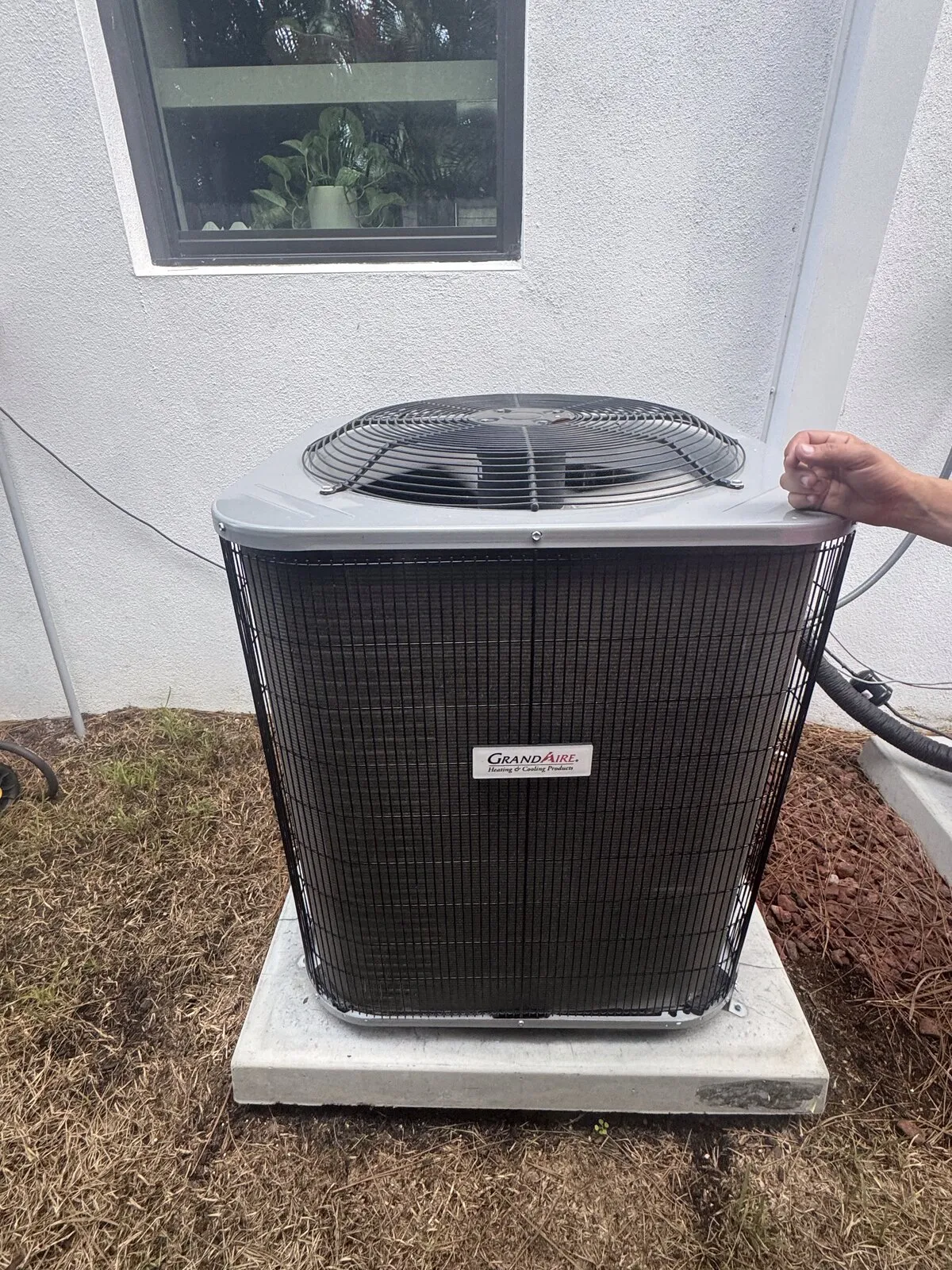
Outside: the condenser
- 1
Condenser coil — washed, not glanced at
A coil packed with dust and grass clippings makes the system run longer for the same cooling. You pay for that on every FPL bill.
- 2
Refrigerant pressures — gauges on, numbers written down
A slow leak never announces itself. Low charge quietly overworks the compressor until it dies — recorded readings catch the trend a year early.
- 3
Compressor amp draw under load
A compressor pulling more current than its rating is asking for help. This reading predicts the most expensive failure an AC has.
- 4
Capacitor tested under load — not just looked at
The small gray can behind a huge share of Florida "AC died today" calls. It weakens for months before it quits; a real test sees it coming.
- 5
Contactor inspection
Pitted contacts either weld shut (AC never stops) or burn open (AC never starts). A five-minute look, an ugly failure avoided.
- 6
Condenser fan motor and blades
Worn bearings and out-of-balance blades hum for weeks, then stop on the hottest day. Noise now is information.
- 7
Disconnect, wiring and connections at the unit
Loose or scorched connections waste power as heat — and in a wet Florida yard, they are a safety item, not a detail.
Inside: the air handler
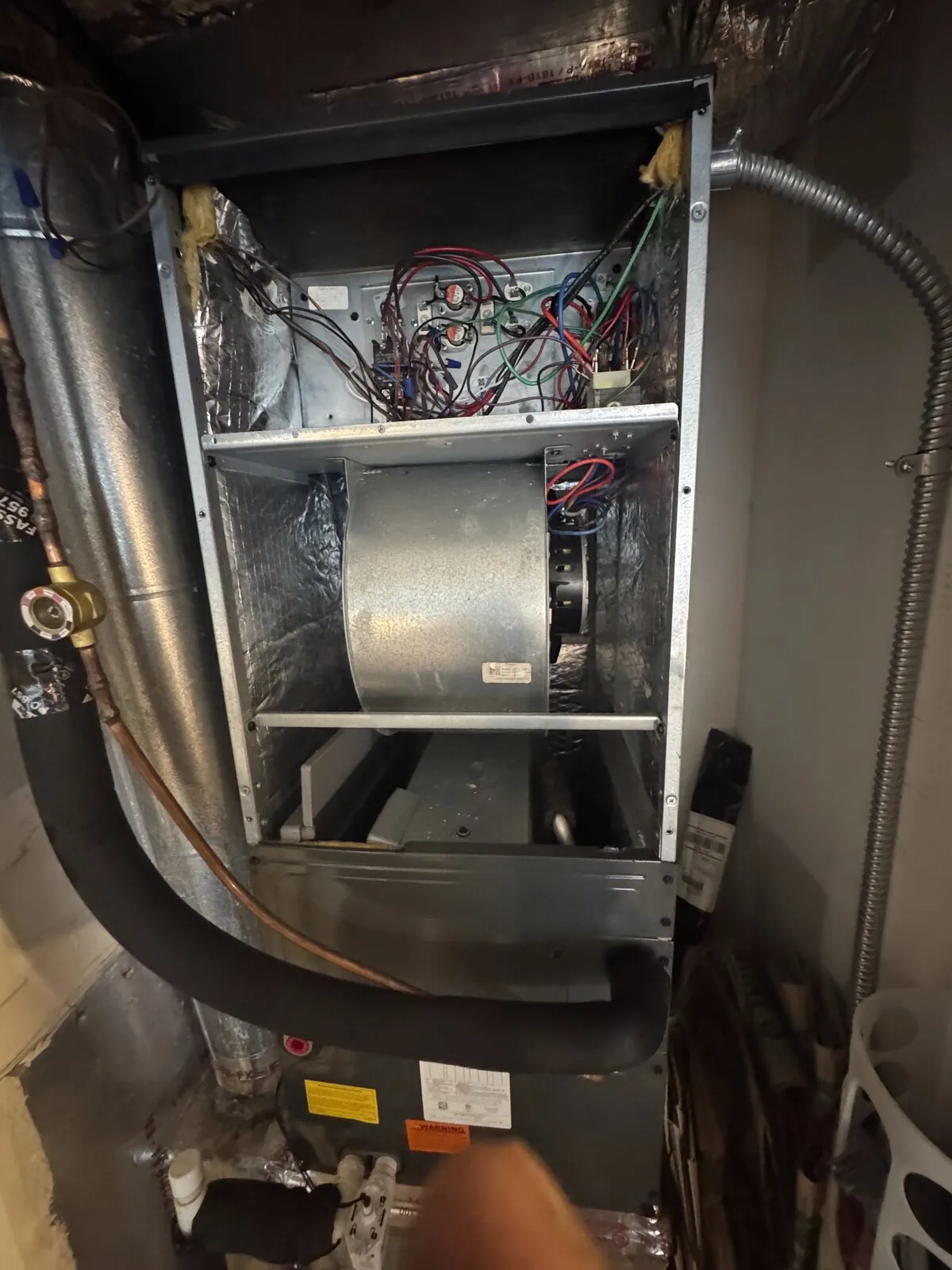
- 8
Evaporator coil inspection
The wet, dark place where the "musty smell" starts. Growth and dust blankets on this coil cost capacity and air quality at the same time.
- 9
Blower wheel and motor
A dirty blower wheel moves noticeably less air. Rooms far from the unit feel it first.
- 10
Air filter — checked, and the right schedule set
Florida systems load filters about twice as fast as the box suggests. We match the schedule to your house, pets included.
- 11
Condensate drain line — flushed, not eyeballed
The number-one preventable AC failure in Florida. A clogged line in July means water on the floor or through the ceiling.
- 12
Drain pan and float switch — tested
The float switch is the $20 device that saves the drywall. It only helps if it actually trips — so we trip it.
- 13
Air handler level and drain slope — checked with a level
A cabinet set a couple of degrees off never drains dry; the standing water grows the sludge that clogs the line again and again. Thirty seconds with a level ends a yearly service call.
- 14
Heat strips / heat mode test
Tested before the first cold front, not during it. Ten minutes in fall saves the one cold morning a year Florida gets.
- 15
Ductwork check at the air handler
Loose connections and sweating ducts at the unit are where attic leaks usually begin — caught here, they stay small.
- 16
Static pressure — measured, not assumed
One manometer reading says whether the duct system is fighting the equipment. High static quietly shortens the blower motor's life; nobody else measures it.
Controls and safety
- 17
Thermostat calibration and settings review
A thermostat reading 2°F off makes a healthy system look broken. Calibration is free suspicion-removal.
- 18
Temperature split — supply vs return, recorded
One number that says whether the system actually cools: typically a 16–22°F drop across the coil. Outside that window, something upstream is wrong.
- 19
Breaker and panel connections for the AC circuits
A breaker that trips in August is rarely the breaker. Tight, cool connections are what we want to see.
- 20
Surge protection check
Tampa Bay is the lightning capital of the US, and surges kill control boards. We check what stands between a strike and yours.
The part you keep
- 21
Photos of what we found
The coil before and after, the readings on the gauges, anything worth watching. You see what we saw.
- 22
Readings compared to the last visit
Maintenance is a trend, not a snapshot. A capacitor at 90% of rating two years running is fine; one that fell from 98% to 90% in a year is a warning.
- 23
Recommendations ranked: fix now / watch / ignore
In plain English, with the "ignore" list included — because an honest report says what you don't need as clearly as what you do.
How often, and what you can do between visits
| Task | Interval | Who |
|---|---|---|
| Replace 1" filter | Every 30–60 days | You |
| Flush the condensate drain with distilled vinegar | Quarterly | You |
| Rinse the condenser coil, power off | Twice a year | You |
| Clear 2 ft around the outdoor unit | Ongoing | You |
| Full inspection | Annually, twice for nine-month duty | A technician |
Vinegar, not bleach. Bleach is hard on the pan, the glue and the metal it touches on the way through.
What maintenance genuinely prevents — and what it doesn't
It prevents drain overflows, the musty-smell air quality problems that start in a wet pan, frozen coils from dirty filters and coils, capacitor failures caught before they strand you, corroded contactors, and the slow efficiency loss that shows up on your bill before it shows up in comfort.
It does not prevent a manufacturing defect, a lightning strike, or the end of a system's natural life. Anyone selling maintenance as insurance against all three is overselling it. We'd rather tell you what the visit is for.
AC Maintenance & Tune-Up: your questions, answered
How much does AC maintenance cost in Tampa?
We're not selling maintenance visits or plans yet, so there's no price on this page. Ranges will appear in our cost guides when we open.
How often should AC maintenance be scheduled in Florida?
Annually at minimum. Twice a year suits a system running nine months, and is what we'd recommend for anything past year seven.
What's included in a real AC tune-up?
The 23 checks above. If a visit doesn't include measured electrical readings, a flushed drain, a tested float switch and measured static pressure, it's an inspection in name only.
Can maintenance prevent breakdowns?
It prevents a specific and common class of them — drain, airflow, coil and electrical failures. It can't prevent age or lightning.
How often should I clean the AC drain line?
Quarterly in Florida. A cup of distilled vinegar down the access tee. It's the cheapest maintenance task that exists and it prevents the most common Florida service call.
Does maintenance cover heating too?
In Tampa Bay it should. Your heat pump is the same air conditioning system running in reverse, so one annual HVAC service visit covers both modes — provided the technician actually tests heating operation instead of only cooling.
Is a maintenance plan worth it?
It depends entirely on what's in it. Compare the checklist, not the monthly price. A cheap plan that skips electrical measurement and static pressure isn't cheaper, it's less.
Be first in line when we open in Tampa Bay!
Texts and messages get the fastest replies — leave your contact and you'll hear from us the day booking opens.
(813) 393-7911