
An AC freezes up for one of two reasons: not enough warm air is moving across the evaporator coil, or there isn't enough refrigerant in it. Everything else on this page is a variation of those two. Turn the system off, run the fan only, give the ice two to four hours to melt, and while you wait, work out which of the two you're dealing with — because if you skip that step, it will freeze again by the weekend.
It looks alarming and it's genuinely counterintuitive. It's 94°F outside, the humidity is at Florida levels, and there is a block of ice on your air conditioner. The AC has, in effect, decided to become a freezer, and it is not asking your opinion.

Sunny City Cooling technician — ice on the coil is airflow or refrigerant, nothing else
Sunny City Cooling · Wesley Chapel, FL · more than 60 years of combined field experience on the team.
Why ice forms on something that's supposed to be cooling your house
The evaporator coil inside your air handler runs cold — colder than the dew point of the air around it. That's the whole point: moisture condenses on it and drips away, which is why your house feels dry as well as cool.
The coil stays above freezing only because a steady stream of warm household air keeps passing over it. Cut off that warm air, or reduce the refrigerant so the coil runs colder than designed, and the condensation on the coil stops being water and starts being ice. Once the first layer of ice forms it insulates the coil, so less heat gets in, so the coil gets colder, so more ice forms. It runs away from you quickly.
Cause one — restricted airflow
The common ones, roughly in the order we find them:
- A dirty air filter. The single most frequent cause of a frozen coil anywhere in the country, and Florida's cooling season is nine months long.
- Closed or blocked supply vents. Closing vents in unused rooms feels like saving money. It reduces total airflow across the coil.
- A blocked return. Furniture in front of the return grille, or a return filter nobody has changed since the house was bought.
- Collapsed or disconnected flex duct. Very common in Florida attics. The system is trying, the air isn't arriving.
- A failing blower motor or a dirty blower wheel. The fan spins, just not hard enough.
- A filthy evaporator coil. Years of fine dust builds a felt blanket on the fins and air can't get through them.
Symptom pattern for airflow problems: weak airflow at the vents even when the coil is clear of ice, a system that runs and runs, dust visible around the register edges.
Cause two — low refrigerant, which means a leak
Refrigerant is not consumed. A system that is low is leaking. Low refrigerant lowers the pressure inside the coil, the coil runs colder than it was designed to, and it freezes even with perfect airflow.
Symptom pattern for refrigerant problems: ice at the outdoor unit on the copper lines as well as indoors, a hissing or bubbling sound near the indoor unit, air that is cool but never cold, and a system that froze up again within days of being thawed.
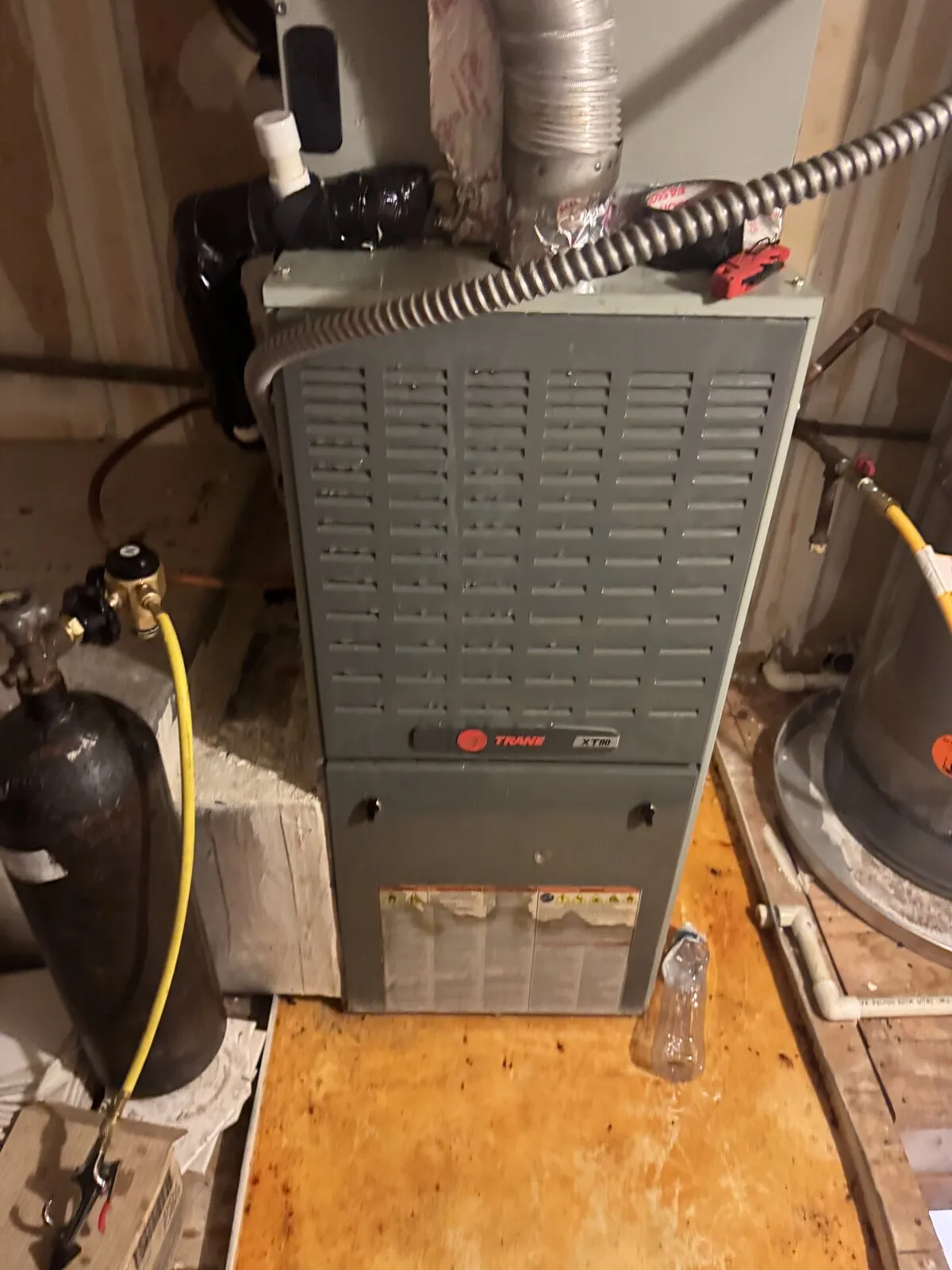
Where those leaks come from, in this climate
Our owner, Anatoli, on what he actually finds:
Refrigerant usually leaks out of microcracks, and microcracks are an aluminium problem. Manufacturers compete on price through materials — the thickness of the copper, or using aluminium instead of copper in the cheaper trims. In an inexpensive unit the condenser and evaporator are essentially all aluminium. Aluminium takes thermal load badly. It cracks, especially when it's poorly insulated and standing in direct sun. And a microcrack leak is hard to find — you're not looking for a hole, you're looking for a seam that weeps. Those systems live about seven years in normal conditions.
That is why "just add refrigerant" is a bad deal dressed as a cheap one. A top-up buys a season. If the coil is weeping, you're paying for refrigerant on a schedule.
| What you observe | Airflow problem | Refrigerant leak |
|---|---|---|
| Filter visibly dirty | Very likely | — |
| Weak airflow at vents with no ice present | Very likely | — |
| Ice on copper lines at the outdoor unit | Sometimes | Very likely |
| Froze again within a week of thawing | Sometimes | Very likely |
| Hissing or bubbling near the indoor unit | — | Very likely |
| System is 7+ years old with an aluminium coil | — | Likely |
What ice buildup on the AC does to the rest of the cooling system
A frozen AC is not only a cooling problem, it is a slow demolition of the HVAC system around it.
Ice buildup on the evaporator coil blocks airflow through the vents, so what little air arrives is barely cooled. As the coil freezes, refrigerant that should have boiled off into gas stays liquid in the refrigerant lines and travels back to the compressor. Compressors handle gas. Liquid entering a compressor is called slugging, and it is one of the few failures that can kill an AC system in a single afternoon.
Meanwhile the melting ice overwhelms the drain pan, which is how a frozen air conditioner often produces a water stain on a ceiling as its first visible symptom. And every cycle the cooling system spends frozen is a cycle where the blower motor works against a wall of ice.
Which is why the instruction on this page is not "keep an eye on it." It's: turn the AC off now, and let it thaw.
How to thaw it safely
- Set the thermostat to OFF, then set the fan to ON. Fan-only circulates household air over the coil and melts the ice far faster than simply shutting everything down. It's the one time the fan switch earns its keep.
- Put towels down. All that ice becomes water, and the drain pan was not sized for it arriving at once. This is a common way people discover they also have a drain problem.
- Wait two to four hours. A heavily iced coil can take longer. Do not chip at ice on the coil with anything, ever — the fins and the tubing are soft, and a punctured coil turns a service call into a coil replacement.
- Change the filter while you wait.
- Restart in COOL and watch it. If it cools normally and stays clear, airflow was your problem. If it ices up again within a few days, it's refrigerant.
Can you keep running it?
No. Running a frozen system pushes liquid refrigerant back toward the compressor instead of gas. Compressors are built to compress gas, not liquid. That is how a $0 filter problem becomes a compressor failure, and a compressor failure on an older system is usually the moment people start pricing a replacement.
When to call a professional about a freeze-up
Our team has more than 60 years of combined experience with frozen coils, and the honest summary is that most of them thaw and behave, and the ones that don't are telling you about a leak.
Call a professional if the AC unit freezes again after a filter change, if there is ice at the outdoor unit as well as indoors, if you hear hissing near the indoor unit, or if the system has been recharged before. Those four all point at refrigerant, and refrigerant work is licensed AC repair work.
Call a professional sooner if the air conditioner freezes while the vents are already delivering almost nothing. Very weak airflow at the vents with a clean filter means the restriction is further in — a clogged evaporator coil, a failing blower, or a collapsed duct — and each of those will keep causing the coil to freeze until someone opens the HVAC system up.
You do not need to call anyone for a first-time freeze on a filthy filter. Change it, thaw it, and watch the AC unit for a week.
How to keep it from happening again
- Change the filter on a schedule you actually keep — in Florida, every 30 to 60 days for a 1" filter.
- Leave the supply vents open. All of them. Every closed vent raises pressure in the duct system and drops airflow across the coil, and a closed vent is one of the quiet ways an AC unit starts to freeze.
- Keep the return grille clear — a sofa in front of the return starves the whole HVAC system.
- Have the condensate drain flushed quarterly so a clog never coincides with a freeze; when both happen together, the thaw water has nowhere to go.
- Have the evaporator coil and blower wheel checked as part of a yearly tune-up; both accumulate slowly and neither is visible from the hallway.
- If the same system has been recharged twice, stop recharging and get the leak found. Ask for the result in writing.
How a freeze-up differs from the other two big AC complaints
| Symptom | What it usually is | Guide |
|---|---|---|
| The AC freezes, ice on coil or refrigerant lines | Airflow or refrigerant | This page |
| The AC blows warm air with no ice | Thermostat, capacitor, outdoor unit, refrigerant | AC blowing warm air |
| Water on the floor, no ice | Clogged condensate drain | AC leaking water |
They overlap. A frozen coil blows warm air and then leaks water when it thaws, so a homeowner can legitimately arrive at any of the three pages with the same air conditioning problem. Ice is the deciding evidence: if there's ice on the cooling system anywhere, start here.
What this costs to put right
Honest ranges rather than a single number, because the spread is wide. A filter is a few dollars. A coil cleaning and a blower service is a routine maintenance visit. A refrigerant leak repair depends entirely on where the leak is — a fitting is minor, a weeping evaporator coil on a seven-year-old aluminium system often costs enough that homeowners start comparing it against the price of a new system. We publish ranges on our cost guides rather than firm quotes, because anyone who gives you a number over the phone is guessing.
More ac problems & symptoms
Your questions, answered
How do I stop my air conditioner from freezing up?
Turn the cooling off, run the fan only until the ice is gone, and replace the air filter. Then identify which of the two root causes you have: restricted airflow, or low refrigerant from a leak. Treating the ice without treating the cause just schedules the next freeze.
Will an AC freeze if it runs all day?
Running all day doesn't freeze a healthy system. It does expose an unhealthy one — a marginal filter or a slow leak will show up as ice during long run times before it shows up any other way.
Is my AC ruined if it freezes up?
Usually not, if you shut it down promptly. Repeated freezing while the system keeps running is what damages compressors.
Should I turn my AC off if it's frozen?
Yes — cooling off, fan on. That's the fastest safe thaw.
How long does a frozen AC take to thaw?
Two to four hours with the fan running; longer for heavy ice. Resist the urge to help it along with a hair dryer or a hose.
Can I fix a frozen AC myself?
The airflow half, yes: filter, vents, return. The refrigerant half, no — finding and repairing a leak and weighing in a correct charge is licensed work with specialized equipment.
My AC froze up again a week later. What does that mean?
It means the first thaw treated the symptom. A system that re-freezes quickly after a filter change is telling you it's low on refrigerant.
Be first in line when we open in Tampa Bay!
Texts and messages get the fastest replies — leave your contact and you'll hear from us the day booking opens.
(813) 393-7911